

AI mania
AI works but can't pay the bills


Note: This article is too long for email, please read in the app or a browser
It seems like it’s time to go dig in the AI world and see what’s going on. This is going to be fairly long so let me summarize this as follows:
AI can be used successfully as a major productivity improver
It can also be abused and become a major productivity sink
It lowers the barrier to creativity significantly, but that’s not necessarily good
It costs a fortune, even if you the user are not paying for it
The big AI companies (OpenAI, Anthropic) are going to fail
The infrastructure built out by/for them is going to be used by others though
AI Can Be Good
There are any number of horror stories about AI going horribly wrong, but when used correctly it is very good. I recently wrote a note in reply to a post beating up AI that included my recent mostly positive experience of using AI to code:
Let me tell you an anecdote of how I spent parts of several days last week. $dayjob had to show something off at a conference last weekend in San Francisco. The Sales guy had an idea and vibe coded it because the rest of us were busy. Well actually he vibe coded about 80% and then got stuck and I was volunteered to fix it. Part of the vibe coded stuff was excellent. Part of it was WTF. And the bit he’d got stuck on was not something I could get an AI to do for me either. BUT I could ask the AI for snippets and that massively shortened the amount of time I had to spend developing. This wasn’t a big task - it was a fairly straight forward web page and some moderately tricky python on the back end to generate the data it needed. AI was generally speaking a massive help in that the sales guy could not have created what he wanted in look and feel without it. AI also massively helped me with python and javascript snippets that I could have written but AI got right first try in 20 seconds whereas it would take me several minutes and I’d likely have typos.
Verdict: AI massive help as an ASSISTANT. But not up to writing complete apps on its own.
To add to this a little. AI probably cut the development time down from a month to a week, where that week was spread out over a couple of actual weeks because we had other things going on at the same time. I figure my sales colleague spent a couple of days noodling in AI between sales activities and then I spent a couple of days figuring out a spec for the final output - not at all full time, and then another week or so actually writing everything, which was done at the same time as my making a quick business trip to Taiwan, Thailand and Tokyo with numerous meetings to take up my time. If I had not had AI to help, I would not have made such a complex spec, and thus the final product would not have been anything like as good.
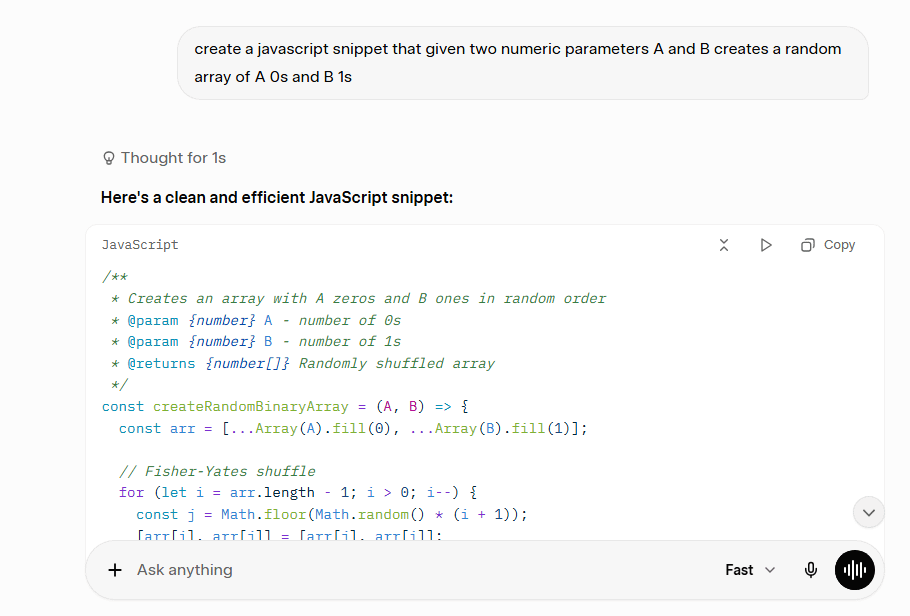
The screenshot above is taken from a section of my actual development. It was where I needed a better way to do something that the sales guy’s vibe coded AI had made overly complex and poorly functional. I didn’t need to use AI to write that snippet but AI (grok) took a couple of seconds to generate two or three alternatives and I used one of them to replace a couple of dozen lines of spaghetti code.
The AI code was correct, suggested some concepts I hadn’t thought of, and lacked the typos I might have included if I had written it by hand. But critically I could inspect the code and see that it made sense.
That goes for the more complex tasks I gave AI. I’d give it a spec that was quite detailed: telling it to use specific APIs/libraries, what I wanted the output to look like, and so on. When it did something wrong I told it specifically what code to change and what I wanted to do. This worked well. The only major issue I had was discovering that $dayjob’s API documentation had bugs in it, which is not something I blame AI for screwing up but which took me quite a lot of time to figure out because the error was so unexpected.
However the project was successful because I treated my AI sessions the same as I would treat Sanjay the outsourced offshored consultant only with a faster response time. This approach works. At a slightly higher level of complexity it is what ES Raymond and similar top programmers use to create a program in a day instead of a month or two. This approach works well. Even people who are skeptical of the large AI companies use it regularly to get good results. Pick your AI tool appropriately, set your guardrails, write your prompt with lots of detail, validate the output and you too can write large complex programs in an afternoon with very few bugs.
Similar preparation and monitoring also works for other tasks, from bug hunting in source code to writing substack articles and creating pictures or videos. While it isn’t exactly the same, OpenAI recently announced that their AI had solved a longstanding mathematics problem although it looks like an actual human had to do some expert prodding to get to a final solution1:
Our new result disproves this conjecture. More precisely, for infinitely many values of n, the proof constructs configurations of n points with at least
\(n^{1+δ}\)unit-distance pairs, for some fixed exponent δ>0. (The original AI proof does not give an explicit δ, but a forthcoming refinement due to Princeton mathematics professor Will Sawin has shown one can take δ=0.014.)
In the writing and research area, an excellent example of using AI to do something that would otherwise take months of work is the following (fascinating) post recommended to me by Noah Smith .

Part of the interest is the way that the author explains is significant detail how he validated the results he’d got from Claude. It obviously took him some considerable time and effort to produce, but without using AI it would have taken very very much longer.
Abuse of AI is a Productivity Sink if not Worse
On the other hand if you skimp on the preparation and the monitoring you’ll end up with a hallucinated mess that may pass a superficial examination but reveals the equivalent of seven fingered hands when looked at more closely. Using AI to fix the hallucination only works some of the time and eventually attempts to get AI to fix AI mistakes end up going nowhere and producing something that cannot be fixed or maintained.
There is a good post at Persuasion about whether AI is more like a bicycle or a locomotive

The TL;DR is that both bikes and trains allow humans to go faster than they can on their own, but bikes do it by making the human more efficient in converting his muscle power into movement while trains just convey the human from point A to B for the price of a ticket.
The effective users of AI treat AI like it is a bicycle. It makes their creative efforts massively more efficient, but they are still providing the basic muscle power to power the system. On the other hand the train requires no more effort from the passenger than just walking on board at the starting station and getting off at the destination.
The problem with AI is that most AI users treat AI like it is a train not a bicycle, and this includes, it seems, the AI companies themselves

This probably explains why - to ESR’s surprise - that
89% of leaders say AI has not improved their company's labor productivity, despite widespread adoption, per Gallup.
The train concept is dangerous and bad. As the Persuasion article notes, AI in this case follows other tech innovations like GPS that end up deskilling the users and thus leaving them unprepared for life without the technology and no way to recognize when the technology is leading them into dangers that the technology is unaware of.
A good practical example of that shows up in this article

The large AI companies (i.e. Anthropic and OpenAI, plus the incestuous collection of cloud companies, startups and VCs related to them) all want the train model. They want it because they want to be able to charge users for the journey. The fact that they are blowing simply ridiculous piles of money and failing to get anything close to cash-flow neutrality let alone profitability is going to be discussed below, for the moment the salient fact is that they want us all to be using AI for everything, whether we want it or not, in the theory that it will make them money as it makes us more successful and happy.
They totally ignore the problems of this approach. The first and simplest is that AI is simply not up to the level of reliability of “Sanjay” let alone a junior employee. If you let it run away and do things, at first this looks wonderful because there’s lots of activity, but as time passes it becomes clear that, as I said above, the output is not 100% of what is wanted, just around 80%-90% and getting it to 100% is harder than starting from scratch unless you knew what you were doing in telling AI what to do when you started using it. So after a while of heavily using AI without training your employees on best practice you end up with a mess which you now have to get your employees to fix and which probably takes longer than development not using AI in the first place would have. In fact El Reg has a link to a report/survey where 80+% of those surveyed have had problems. The reg article has some other interesting factoids:
The result is that more than half (52 percent) of those surveyed report an uptick in software development output. And while 68 percent of organizations appear to be convinced AI is delivering business value, only 31 percent of AI-related spending can be linked to specific business results. In 36 percent of organizations, AI spending is tracked without measuring the return on investment or isn’t tracked at all.
With more code comes more cost from infrastructure spending, in the form of increased CI/CD, testing, and security scanning. Some 54 percent of respondents said CI/CD infrastructure spending has risen significantly in the past 12 months, and 53 percent flagged rising testing, security, and deployment costs.
Only 45 percent of respondents say these costs are predictable quarter to quarter. Yet relatively few organizations have taken steps to control AI spending: 27 percent report quotas or limits on token usage, while just 18 percent have automated spending controls.
There’s a related problem here in that the half-baked AI slop output of these projects will often become part of the training input for the next generation of AI, meaning that generic AI is likely to gradually produce worse outcomes because it has been trained on worse input data with no one correcting for quality.
In addition, thanks to the known traits of sycophancy and similar in AI models today, users who have little or no knowledge of a subject can be convinced by AI that they are experts and/or that the AI solution is correct when it is not so. There are numerous examples of both of these events happening. It is my strong belief that we will see some major financial pain occurring from someone’s faith in AI turning out to be wrong.
The AI companies actually have a commercial interest in us all becoming stupid and depending on AI for the simplest task. I’m not saying they have consciously decided to try and dumb us all down, but the incentives for them are certainly to get us all hooked on asking our AI assistant to do everything for us and then charging us money every time we use the assistant. There are some economic problems with that concept that I’ll get to later, but it is clearly an incentive structure and, given the way Google, Microsoft and apparently every other major tech company are throwing AI “Clippy”s at us, it seems like they are trying to execute on it. Indeed they are “altruistically” suggesting that humans all get some kind of Universal Basic Income to replace the jobs that AI has taken away from us.

This is a stupid idea on many many levels, and Jordan Schachtel explains some of them. I am just going to ask one question. Who will pay for the UBI? Because it isn’t, on current trajectories, going to be the AI companies as they can’t do anything other than burn cash themselves.
Considering that we haven’t yet fully digested the impact of pervasive social media on society, other than generally bad, and we know that the social media companies have worked hard to make their products more addictive, having AI companies try the same by bombarding us with AI positive “news” and ads for barely adequate AI slop is not good.
The fact that AI produces slop is bad. A worse thing is that AI is often a major security hole and the train model where you just let AI do all the work, also keeps you oblivious to the security holes it introduces. There are numerous ways this happens.
The first is that AI writes code with exploitable security holes in it. There are any number of examples of this and it probably shouldn’t be that surprising since the AI training data includes public git repositories that are full of insecure crap. If you vibe code you can’t spot the issue, indeed you may not be aware that it is an issue.
I have concrete example of this: a few months ago I used AI to write a web calendaring app for some friends and it put most of the authentication code in the browser instead of the back end. The result of this was that a hacker who wanted to crack my app could have created his own generated session cookie and got access without needing to know the password of the users he was trying to spoof. In my case a) I spotted the problem and b) the app was sufficiently trivial that there was nothing that really mattered behind the authentication (which was mostly just there to stop driveby bots and hackers screwing with the page), however it is easy to see how someone who didn’t pay as much attention to the output could have let this bug through for a site that collected far more critical data.
I strongly suspect that there are similar gaping issues in other production uses of AI beyond coding. If anyone is using AI to, say, design a house I’d want to look really closely at the output to make sure it didn’t propose something stupid and/or dangerous.
The second is that the AI toolchain may have security holes in it - in the case of a recent claude one, my suspicion is that AI vibe coding may have been responsible for the hole. We have seen others where the AI vendors themselves seem to get infected and that of course means that bad guys could potentially infect anyone using the official tools provided. Absolutely nothing I have seen from the major AI companies gives me any confidence that they take security particularly seriously, in fact they seem to have a very 1990s Microsoft attitude to the whole thing, preferring to provide new features and so on faster without taking into account whether the new feature is a security/privacy nightmare or not. Combine this with AI agents their known security issues (a quote from I forget who: “We just about convinced users to not click on links sent from strangers, now we have AI agents who love clicking on random links”) and you have a recipe for PWNage of your AI systems by the bad guys. Whether they delete the data, ask for a ransom, steal your data or do something else is unclear, the problem is that they can do it before you can stop them, or even be aware that they are doing things they should not do.
A third is that the public AI services seem to have a fairly lax concept of “privacy”. In fact the large AI companies seem to have a similar concept of “yours” vs “ours” vs “mine” to toddlers and excessively possessive girl/boyfriends.
[ That’s not your valuable beloved collectible T shirt, it’s ours… I’m wearing it more because it makes me look cute… you don’t wear it so now it’s mine… I sold that crappy T shirt because I’m tired of it and some guy in Chicago offered me $20 on ebay for it ]
There are reports that some AI tools have used artwork submitted by one user for AI to work on in output the AI made for a different user, which is bad. Given that the AI companies have been documented pirating books and movies to use as training data I suspect there are many examples of this. Relatedly, I have reason to believe that if you know a business competitor has, for example, used a particular AI to reply to bids or RFPs it may be possible to extract much of that AI generated bid/RFP text, including sensitive details like pricing with some careful prompting. It seems quite possible that similar tricks could result in the leakage of, say, financial results before they are publicly released or other sensitive data.
At this point is perhaps worth extending the saying about cloud computing - there’s no such thing as the cloud, it’s all someone else’s computer - to AI with an explicit nod to the fact that because of the incestuous nature of the AI companies it can be extremely unclear which companies’ AIs can see your data. The large cloud companies (AWS, Azure, Google …) make specific claims/products for encryption of data at rest and so on to try alleviate the security/privacy issues, the AI companies do not seem to make the same claims or offer similar features.
The Harm of Lowering the Barriers
A lot of creative sorts - artists, writers, translators, editors - are concerned about AI impacting their livelihoods. You can roll your eyes, mutter something about Luddites and have a partial point because a lot of the time AI is making something possible that would not be done if a human were required to do it.
When X introduced good semi-automatic translation, it didn’t impact translators but did allow many US and Japanese Xers to connect in ways they could not before because of language issues. When I (or people like me) use AI to create an image for a substack post or a meme, I’m not putting an artist or graphic designer in trouble because if AI wasn’t there I’d either use my limited Irfanview/Gimp skills to make it or forego the opportunity to illustrate my post.
But there are areas where the skepticism of artists and others is warranted. Lucy Pepper writes about some of them here (I linked to Lucy’s part 2 above, regarding the dangers of AI as train )
Fundamentally AI allows a lot of people to produce low quality stuff and that impacts the creators of higher quality stuff.
First there’s the way that AI simply steals the base concepts from the original artists. Yes the Studio Ghibli memes were amusing, but if you were a Studio Ghibli animator they would be a lot less amusing because that’s some machine taking concepts you spent months learning/developing and making shoddy versions of it. That’s very demotivating and means that fewer younger generation people will want to do the job. It also in the medium term means fewer people will be able to do the job because (see deskilling mention above) they have never learned the basics due to using AI to generate the images instead. That would be fine if AI were really able to generate new looks, but it really isn’t. It can generate pastiches, it can generate interesting composites, but it really can’t do new. The programmers who use AI to write new programs aren’t inventing new algorithms or more efficient ways to do things, they are just putting known building blocks together in new custom ways. This is absolutely true for websites and documents too. It also applies to translations. The AI has an encyclopedic broad memory and it can (see the mathematical discovery) see surprising connections between one area of knowledge and another, but it really can’t innovate.
Still it is likely that some genius computer programmer will come up with an elegant new algorithm to solve some problem and use AI to write some of the code, but the AI will not have created the algorithm, it is just using standard tools to implement the algorithm it has been provided with. Much the same may well apply to other creative arts. I can absolutely see the use of AI taking the part of the lowly paid apprentices that major painters of the past used to use to do the boring bits [ Draw 50 different trees in detail on the left …] but again this is the use of AI as bicycle rather than train.
Now you may say that we have enough art (you can certainly say we have enough (post) modern art) but surely there are plenty of areas where something new would be appreciated. Moreover if if AI becomes our apprentice, where do we get the next generation of artists because they won’t have been apprentices? See also musicians, programmers, writers etc. AI in “train mode” basically kills the pipeline of new entrants to any craft it is involved in.
AI Costs a Fortune
This is something that people don’t seem to properly appreciate. The AI companies are seeing increases in revenue, but they are also continuing to spend several dollars per dollar they receive.
Now, part of the reason for this is that the big AI companies are continually developing newer (and they hope better) models able to do more with fewer errors and that costs. And it is also true that, after several years of giving the product away for nearly free, the AI companies are beginning to charge many users roughly what it costs them to perform the tasks given. Although, as this article points out they have some way to go to get to actually charging the full costs consistently.
But even so, it seems that the AI companies are not in fact at break even on their compute costs for inference2 although they claim that they are and apply fuzzy AI math to get there. For example, Anthropic claimed (archive) that it would make a $559M operating profit for the April-June 2026 quarter. Despite the impressive predictive ability (we are still several days away from June), it seems likely that, if true, this is going to be due to Anthropic getting a specific two month discount on the $1.25B/month it is going to the paying Musk’s SpaceX for AI compute after June.
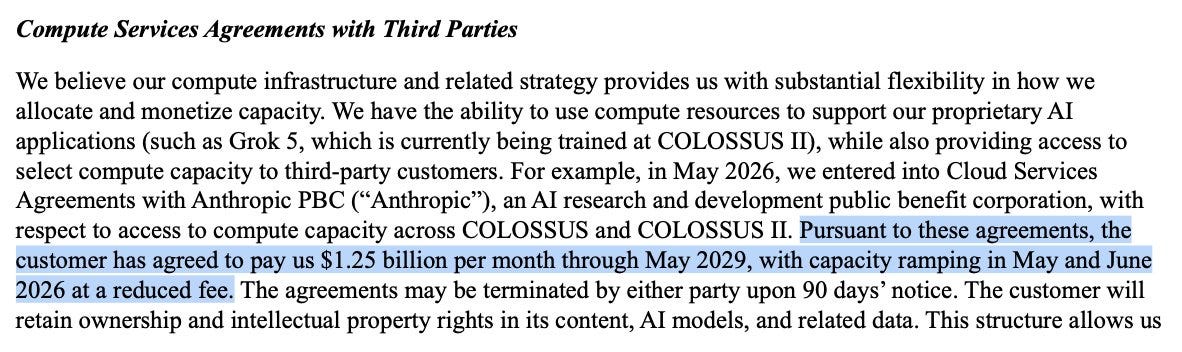
Ed Zitron (from whom I took the S1 image) goes into rather more detail, and I think he’s generally speaking correct. Anthropic is playing revenue and expense tricks to make itself appear profitable and SpaceX is happy to help because a company paying $15B/year that is not making a loss is much more impressive to IPO investors than one where SpaceX might have to send around some collections agents because its deadbeat customer owes it several billion for usage it hasn’t paid for. In fact even the WSJ article notes that the accounting seems less the clear:
It is unclear what accounting methods Anthropic has used to book revenue and costs, as the company isn’t yet required to follow the financial-reporting requirements of a public company.
Anthropic and OpenAI both account for revenue differently in ways that can make comparisons between the two companies difficult. Anthropic counts sales of its technology through cloud partners as revenue, while OpenAI doesn’t. An Anthropic spokeswoman has said this is consistent with standard accounting practices because the company is the principal in the transaction.
However, let us assume, to be generous that Anthropic and OpenAI (and Google Gemini, SpaceX etc.) can charge paying end users the cost of their transactions. That still leaves several costs unaccounted for.
First there are the free tier users. The companies are extremely opaque about how many of these users they have and how active they are - it seems to depend on whether they want to claim usage growth or emphasize revenue growth - but there is no doubt that the numbers of them are significant and that they consume a significant fraction of the compute power of the AI companies. The students asking ChatGPT to write an essay for them and other similar sorts are unlikely to ever pay the full amount of their compute costs even if the AI companies get them onto some kind of $10/month plan. That’s not just because they are unwilling to, it’s because they lack the money to do so. Some might manage to pay a $50/mo subscription, but that’s probably the maximum, and unless the AI companies strictly limit it, their usage is likely to be not far off the $200/mo plans offered to commercial customers. If they are charged their actual cost of usage they will stop using it, which is probably a good thing, but goes contrary to the plans of big tech who want such people hooked on AI. It is hard to see how to get someone else to pay their costs for them either - advertising simply isn’t going to cut it.
[This essay on the historic impact of Lady Jane Grey brought to you by Twinings, purveyors of Earl Grey Tea to His Majesty since 1797…]
Institutional licenses, where a school district, say, pays for AI access for all its students are also probably a non starter because the school districts that would want to do this are the school districts filled with expensive unionized teachers and administrators. Yes if you fired 90% of the administrators you might be able to pay for the AI subscription3, but we know that simply isn’t going to happen. Neither is firing 90% of the teachers and probably both would be required to balance the books. Raising taxes to pay for it may be attempted but I can see that being shot down by voters.
The problem here is that the marginal cost of an additional AI user is very different to the marginal cost of an additional social media user and the models that work with the latter simply don’t work with the former. I don’t have precise numbers (because as noted repeatedly, the AI companies are very opaque about this) but my strong suspicion is that a new AI user costs the company providing service a couple of orders of magnitude (i.e 100x) the cost of a new social media one. That is to say that if it costs Meta $1/month(year?) for the storage etc. to support a new Instagram account, it costs OpenAI $100/month(year?) for a new ChatGPT user. For Meta, a few years of limited income from the new Instagram user is easy to absorb, for ChatGPT, which doesn’t have the advertising income of Instagram and relies on subscription income, it isn’t.
Beyond the free users, there’s the ever increasing cost of training. Ed Z has made the point that the training/inference divide is somewhat arbitrary because (my metaphor) like a shark that drowns if it isn’t moving, the AI companies have to keep improving their models and they way they do that is by throwing every larger amounts of compute at ever larger amounts of data. It is almost certain that training new models costs just as much, if not more, as running inference on the existing ones which means that even if, miraculously, AI companies get users to pay for 100% of the inference costs they will still be losing $1 for every $1 of income. Maybe this cost will drop with the introduction of new hardware (not quite sure what new hardware, but perhaps there’s some out there) but it seems unlikely to drop by an order of magnitude which is what is needed to for AI to turn a profit.
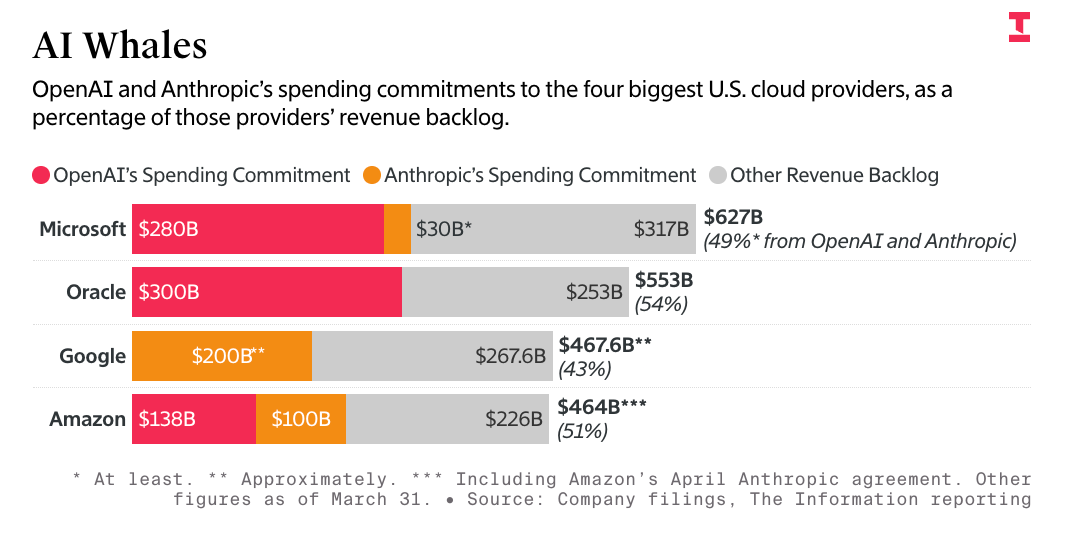
We note that both Anthropic and Open AI are continually raising more money and are continually signing revenue commitments for the future with the various hyperscaler clouds. Ed Z has a pretty good run down of all the promises being made.
Then there’s all the overhead. OpenAI has somewhere around 5000-7000 employees (I think - see opaque numbers), Anthropic has about half that (again I think), both are hiring fast and paying large salaries for the employees they do hire. They also have considerable office space and other perks. It seems likely that basic employment related costs are on the order of $1B/year for Anthropic and double that for OpenAI. Back of the envelope calculation: at $250k / employee, 4 employees cost $1M and 4000 cost $1B, my understanding is that many employees make more than $250k/year. In theory, for companies that are generating $Billions in revenue per year, these are not unreasonable. But it looks like both companies are going to spend at least $2 for every $1 of income on compute costs so having ~$1-2B in payroll and benefits is not a small additional loss. Moreover, in addition to the core AI, both companies are developing software to make the AI usable: coding agents and harnesses, general agentic AI tool kits, skills libraries and so on. And of course there’s the documentation, the marketing, HR and so on.
You do have to wonder why they have these people and don’t use AI to do it.
Except that, of course, you don’t because we already know that Anthropic uses AI to develop its coding harnesses and, as the “Snake that Ate Itself” link above explains, the AI code is poor quality. Apparently the AI companies are not willing to use AI for all their ancillary tasks because they just know that the AI HR or legal is going to be trouble.
Fundamentally these companies are awash in cash (though they keep having to ask people for more) and have never had to budget because their backers seem willing to keep on writing large checks. If (when?) they IPO they expect the general public to continue to fund them in similarly lavish style. They have never had to make a choice about whether to keep a server going or buy a new one, they have never had to choose between hiring a QA tester or a HR worker. They have never, actually, had to do anything efficiently which you can tell if you are a programmer because, even ignoring the AI bits, their code is bloated and filled with dependency chains that are almost certainly unnecessary if someone just spent an couple of hours doing a proper code review and cleaned out the cruft. The same general attitude applies to the rest of the organization because it is part of the culture. The bosses like to say they are startups, but they aren’t really. Real startups have CEOs who worry about meeting payroll next month, I don’t think any of the AI companies have ever come close to that.
That means, eventually, they are going to fail because at some point, just like socialists, they will run out of other people’s money. Given that the AI and related data-center boom has sucked out most of the VC money and seems likely to also swallow serious amounts of junk bond equivalent capital that’s a problem because the smash is probably going to be financially painful and that pain is going to be spread around because while you personally may not have invested directly in them, chances are some fund you have bought will turn out to be exposed, possibly in a way it did not expect. Companies like Oracle or Softbank could be the first fallers, but when they fall the incestuous circular nature of AI funding means that their failures are likely to trigger problems at everyone else too, from NVIDIA to Amazon, Google and Microsoft in addition to Open AI and Anthropic and all the AI companies that use their services. Exposure to Amazon, Google etc. is going cover a lot of people. The only company that may come out relatively well is SpaceX because Elon Musk is a lot less tolerant of featherbedding and inefficiency than other companies. Also SpaceX is successfully building new data centers while Anthropic and Open AI aren’t. Indeed as I noted above, right now in fact SpaceX is renting out some of that data center capacity to Anthropic.
The Infrastructure Survives To Benefit All
However the good news is that while the $100 Billions of investment will not make the current AI companies and their backers any money, the hardware and the data centers are still going to be useful once they have been sold off at a discount. You may even manage to to get a deal on access to your own private cluster of hardware in one such, which is a worthwhile thing.
More critically, while the big AI companies are continually pushing the envelope to get new better models that enable their train concept, if you are willing to go for the bicycle mode of AI use, then today’s existing open-sourced models are probably quite good enough as this article explains, even on relatively old low powered hardware

On that note, the current grok model, which I used for some of the work I started this post off with, is going to be open sourced later this year according to Elon Musk. If (when) the AI bubble pops, running that model on your own hardware bought for cheap will be a worthwhile thing.
There are many benefits to doing this kind of thing, though some MBA sorts will not agree and may be surprised. Nobody expect the Personal AI. The main benefit of Personal AI is control, control and security. The two main benefits are control, security and privacy… (sorry I need to stop channelling Monty Python)
However it is true. Running your own AI solves many issues regarding privacy security and control4. It also will tend to tilt you towards the bicycle model rather than the train one which I feel is both healthier and ethically better. I get that some purists will still disapprove but (sorry Lucy Pepper ) for many this will be acceptable use of AI, even when it is used to generate art. Your own AI agent running a local model can be trusted with your own confidential documents. If you put appropriate security gateways in front of it you can stop it doing stupidly dangerous things and so on. That isn’t going to stop you from having AI disasters, because AI is a dangerous tool just like a saw or lathe. However just as users of power tools are heavily incented to learn how to operate them safely, so too with private AI.
Not only does having to learn how to use them safely protect you, it also teaches you important lessons and those lessons will help make you a better user of AI. Now of course some people will still insist on using AI in train mode, and no doubt some companies will offer that service to them, but I’m fairly sure these new offerings will be priced at actual cost and that is going to limit interest significantly.
If it costs you $40,000 in AI costs to replace a $40,000 salaried employee then the AI had better be better than the employee. Perhaps it will be, after all it doesn’t need time off to sleep, have a family etc., but quite possibly it will end up hallucinating something important about your tax return and get the IRS down on you for an audit. At which point having a human, even if they want to only work 40 hours a week, seems like a bargain.
And that, is probably where we are going with AI. It’s not going to replace every office job, it is going to take the drudgery out of many of them and mean that fewer such roles are required per organization. It is going to enable a single AI wrangler to be incredibly productive and that’s going to grow the economy and give us more jobs.
More details and skepticism in this substack which also quotes an expert as saying
I don’t think it’s accurate to say these examples of AI-supported mathematics mean the models are somehow “smarter” than human mathematicians. I think a better analogy might be how computer tools helped architects produce much more daring and complicated designs (like the Frank Gehry-designed Stata Center where I did my CS doctoral and postdoctoral work at MIT). These tools weren’t better architects than humans but made humans more capable architects.
Inference is the part the customers directly interface with, training is the new model development.
Might be able to but probably not. Assume a school district with 10,000 students in K-12 and $100/mo/student as the required institutional subscription that covers costs. $100 x 12 x 10,000 is $12M. That’s a lot of $200k salaries that need to be eliminated
For a practical guide to creating your personal AI - https://www.jaredwatkins.com/posts/2026/05/smb-inference-stack/
I forgive you, Francis ;)
If we could get the whole world to understand the bicycle vs train analogy, I’d be happy…
BE A BICYCLE!!
(might need a drawing)
No one expects the Personal AI!