

Japan's Election
Some observations and thoughts

Note: I started writing this post before the election, but didn’t hit publish until the results on Monday. There may be some odd verbal tenses and the like as a result, for which I apologize.
PM Takaichi called this election when she didn’t have to because she wanted to have a majority in the lower house of parliament. Although there were vague rumors, as far as I can tell, she achieved surprise when announcing her plans and thus caught many politicians off balance. Some of those she caught off balance were in her own party the LDP, which is actually a sign that she had no leaks and thus probably good. On the other hand maybe if a few more people had known they might have convinced her to change her mind about the date chosen.
The Date & Turnout
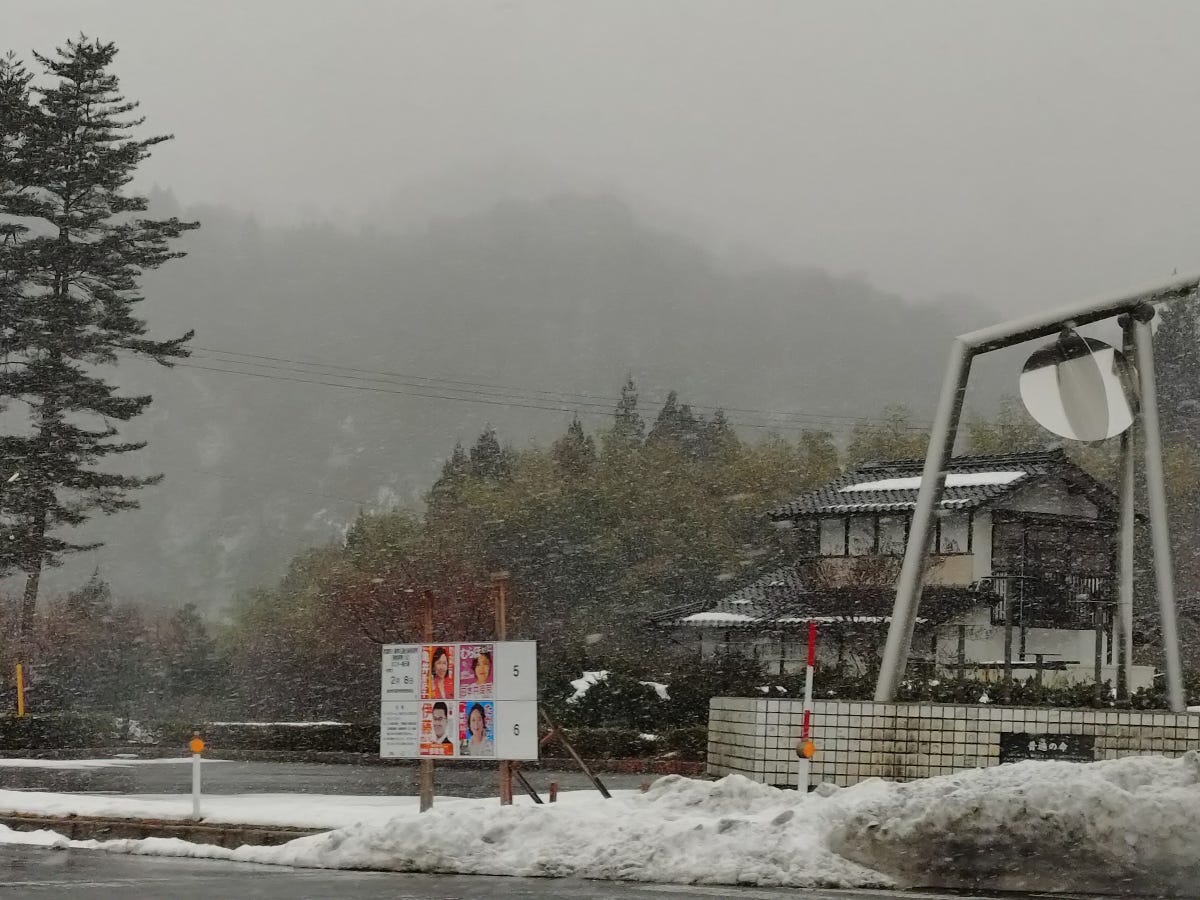
Her choice of election date - February 8th - was definitely considered by many to be inconvenient, and it turns out the winter snow storms on election day made it even more inconvenient that normal. I saw reports that the weather had made early voting turn out to be lower - though that might also be lack of interest - and apparently was an outlier as early voting turned out to be massively more popular than in previous elections. It also coincided with the key pre-exam cramming/panicking season for high school students - many of whom are 18 and thus able to vote - and I think also for some university students too. I suspected this means that turn out - particularly in the snow storm hit north and west - would be low, but that prediction was also completely wrong with turnout up slightly overall, though at ~56% still low compared to many elections in other countries. Despite the turn out increase, I suspect the bad weather and timing were advantages. An inconvenient election removes the people who don’t care so much and based on opinion polls Takaishi has a solid personal following that borders on the fanatical so her fans were more likely to vote that those for the opposition.
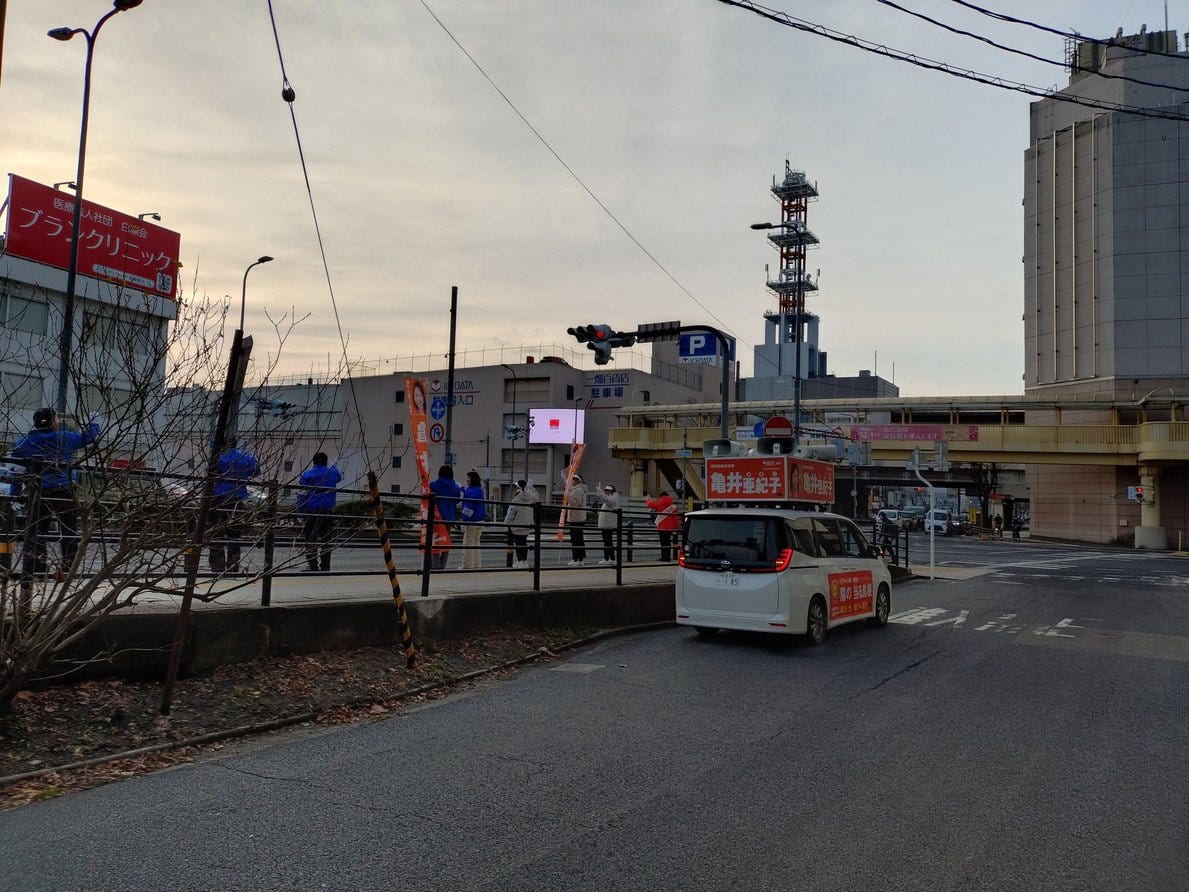
On that note. The snap election also forced the slow dance of merger/alliance between Komeito and the Rikken Minshuto to be consummated in a shotgun marriage to become a new merged party the Chudo. Although here in Shimane that seems to have been fairly successful, with people I know supporting Komeito putting up Chudo posters and getting out to provide support to the former Rikken Minshuto candidates, there have been many reports in the media that overall the new party isn’t exactly a success.
This brings us back to the turnout question. If you weren’t motivated by the merged party policies (which are unclear but seem to be mostly “keep doing the same old and be nice”) then you may well have been tempted to stay home and not bother voting. That may well explain the total collapse of the Chudo seats to roughly half what they had before.
The Policies
Tobias Harris has an excellent post about the final day of the election campaign where he talks a bit about the policies on offer.

Or rather the vision, because the policies being proposed have not been articulated much by anyone. First Takaichi:
Her final night stump speech was similar to virtually all of her other campaign stump speeches. She is not talking about specific policies – the much-debated consumption tax cut, for example – but a more comprehensive vision for the country. Indeed, Takaichi, not unlike her political mentor Abe Shinzō, is refreshingly frank about her vision for Japan. She spends most of her speech talking about the need to raise investment in the interest of promoting national autonomy and self-reliance.
And then the Chudo:
However, what is ultimately most striking about both Saitō and Noda’s remarks is how backwards looking they are. They both repeatedly refer to Japan as a “peace-loving nation” (平和国家), referring to the postwar legacy surrounding Article 9 of the constitution. They warn of the dangers of Japan being drawn into war under Takaichi. They defend the three non-nuclear principles and warn that with a large majority Takaichi will pursue constitution revision and “full spectrum” collective self-defense. Noda uses a portion of his remarks to discuss how policies pursued by the Koizumi and second Abe administrations made Japanese society more unequal. They both talked about Takaichi’s LDP moving to the right. But for many voters this rhetoric falls on deaf ears. It's political rhetoric for people who still get home newspaper delivery.
This is, I think, the key difference. Takaichi has a positive vision for Japan and a future where Japan is an important global and regional player with a thriving economy. The Chudo (and AFAICT all the other lefty opposition parties) seem to have a message of managed decline instead which may appeal to the larger older electorate, but is absolutely not a message for younger people or people who want their children to live in a successful country.
And it is, IMHO, somewhat revolutionary for the LDP as a whole. In the past the LDP was the boring party your (grand)parents voted for and young people who wanted change voted for someone else. Now the LDP is trying to position itself as the party for young people who want change, which sucks up the rhetoric and supporters of parties like Sanseito and Reiwa (although Sanseito increased its representation significantly - from 2 to 15 - it fell far short of its goals and the predictions from a few months ago). Takaichi’s mentor, Abe, did this to a degree, but thanks to his longevity at the top it was harder for him to convince people that he was actually a reformer (though he was in many ways) and not part of the corrupt existing order (which he also was, especially on the corrupt side). Takaichi has less historical baggage (not none, for sure, but less) and seems less beholden to the fossilized faction leaders of the old LDP - Taro Aso for example - though she, obviously, works with them and may even share some of their beliefs and aspirations.
The Trump Effect?
I suspect that President Trump may try and take some credit for Takaichi’s massive victory, and he may be partly correct but indirectly. He did endorse her on Truth Social but there was limited coverage of that in Japan because the international “Trump has cooties” coverage by the media definitely applies in Japan. Thus it was possible that his endorsement would be seen as a negative by the Japanese electorate. However, indirectly, I think he helped by creating the requirement that Japan stand up for itself and become a leader in East Asia and no longer sit passively by relying on the US to keep the Chicoms in check. There are parts of this resurgent Japan rhetoric that concern me, but overall I think that it has been unhealthy for Japan to be so dependent and being under the US umbrella allowed Japan to avoid debate about things like nuclear weapons that it absolutely needs to have1.
I do think that Trump has also strengthened the ability of nationalists of all stripes in all countries to make their case. He is dismantling the post WW2 international order, which, again, is something that is beneficial since that order has, IMHO, lasted a good 30 years longer than it should have. That, of course, means that people like Takaichi (and Abe formerly) have an ally in their plans to have Japan reform its pacifist constitution that assumed the existence of effective international bodies like the UN and which are untenable in the current situation where such bodies have become corrupt cesspools dominated by non-democratic nations. Trump has ripped aside the curtain and made clear that the US is uninterested in sponsoring bodies that effectively provide opposition to the US while benefiting from US largess. In this new environment Japan has to become more assertive and Takaichi is the leader with the clearest plan to do that.
Affordability and the Future
As Tobias noted, one of the big issues of the campaign was that of affordability and the cost of living. To that end I think just about every party promised to remove the sales tax on food. A big test of whether Takaichi can be trusted, is whether she follows through on this, because the BoJ and the financial system in general seem opposed to it. I expect she will, in fact she was asked about this today? (or was it last night?) and she committed to doing so. One assumes that this will be a major part of the delayed budget and it will be fascinating to see how the financial markets take it.
This leads to a follow on question. To what extent will Takaichi be able to govern like her heroine, Mrs T? and to what extent will she turn out to be more like one of her successors, Liz Truss, who was comprehensively rolled by the bureaucracy? Another possible example is Boris Johnson who ended up doing very little that he was elected to do and in fact did a whole bunch of things that he was elected to not do and this paved the way for the disaster that is 2Tier Keir.
I think she’s in a stronger position than Boris was, let alone Liz Truss, and I think she’s far more ideologically consistent so I expect her to trample over her nay-sayers but if the yen and Japanese markets fall things may get interesting. On that note, despite President Trump posting congratulations on Truth Social, one her her early challenges is her meeting with him next month where he is likely to demand concessions. Trump has also, apparently, been upset about her anti-Chicom rhetoric as he feels that has not helped him in his plans to negotiate with Winnie the Flu. I’m not sure that is entirely true, because Trump certainly wants Japan to step up militarily, but he does love making deals and may as a result want to get one with the PRC that is not in Japan’s favor. Her ability to manage the Trump relationship is going to be critical to her success. I think she will probably succeed in that, she seems to get on well with him and he definitely liked her mentor Abe. In fact they seem to share mostly similar worldviews; the main friction being that, naturally, sometimes Making Japan Great Again may come at the expense of Making America Great Again and vice versa. On the whole though, this election has shown Takaichi’s ability to read the nation well, which bodes well for the future
PS Another stats heavy post about the totality of Takaichi’s win here
Also this one on energy (and Australia)

I personally think that Japan needs to have nuclear weapons to deter both the Chicoms and the Norks but that case needs to be made and put to the Japanese public and it really hasn’t yet
I actually don't see a rising modern Japan as a problem, especially if they can somehow rekindle the enthusiasm and confidence of their younger population enough to start having more babies and stick around to be good parents.
Most of my Kansai friends,on the other side of the mountains from you are strongly against Takaichi and LDP's policies. My friends there are also older than dirt (Almost as old as me!) and are surprised at the support Takaichi receives from the youngsters.
I suspect with the present leadership Japan/U.S. relations will be quite satisfactory for both sides. President Trump is America, his country, first (Odd for a world leader now.) and it seems to me there is much room for arrangements, beneficial to both nations.
Takaichi's Japan first, he'll understand and appreciate and their common viewpoint, I think a great starting point for negotiations.
Time will tell, but as you said about her reading the nation well, that and much else these days, and in spite of much else these days, bodes well for the future.